Taoxichuan – Immediately Available Series Blind Boxes
2025 年 11 月 14 日
Taoxichuan – Daguo Porcelain Blind Box
2025 年 11 月 15 日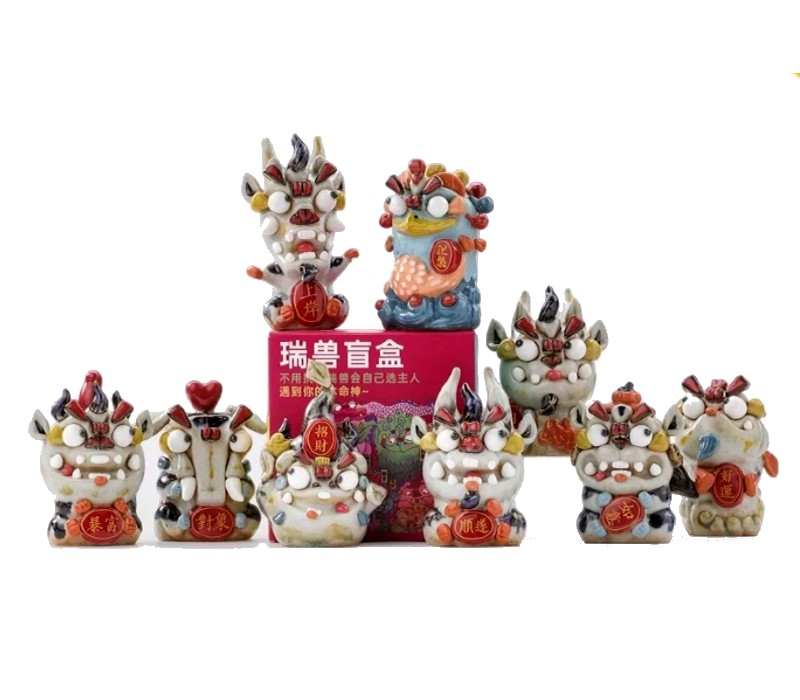
Taoxichuan – Ceramic Auspicious Beast Blind Box
$106.00
9 Styles:
Lion (Ruyi)
Dragon (Smooth Sailing)
Qilin (Good Fortune)
Pixiu (Sudden Wealth)
Carp (Good Luck)
Golden Toad (Attracting Wealth)
Partner (Marriage)
Baxia (Going Ashore)
Nirvana (Hidden Edition)
9 Styles:
Lion (Ruyi)
Dragon (Smooth Sailing)
Qilin (Good Fortune)
Pixiu (Sudden Wealth)
Carp (Good Luck)
Golden Toad (Attracting Wealth)
Partner (Marriage)
Baxia (Going Ashore)
Nirvana (Hidden Edition)
Nirvana (Hidden Edition): Auspicious beasts are important symbols in traditional Chinese culture, symbolizing good fortune, happiness, and peace, carrying rich cultural connotations and beautiful meanings. Integrating auspicious beast elements into the blind box design, combined with Jingdezhen ceramic craftsmanship, presents a novel and interesting way to inherit and promote traditional culture, allowing more people to understand and appreciate auspicious beasts and experience the charm of traditional culture. Creating a national trend spirit totem for contemporary young people.
.png#1780)
Lion (Ruyi)
Auspicious Lions at Home: The lion symbolizes good fortune. In traditional Chinese culture, the lion is a clever and innovative symbol that blends the auspicious image of the lion with the auspicious meaning of "everything goes well." It conveys blessings through homophones and transmits strength and good wishes through symbolism. Stone lions symbolizing good fortune and peace are often placed on both sides of the main gate to ward off evil spirits and protect the home. Folklore says that red eyes in stone lions can foretell floods or earthquakes. For wealth and prosperity, banks and shops often display lions to symbolize abundant wealth, such as "Lion Rolling an Embroidered Ball," which signifies continuous wealth.
The lions in front of ancient official residences symbolized family prosperity: the male on the left (stepping on an embroidered ball, symbolizing power), and the female on the right (cuddling a cub, symbolizing the continuation of offspring). The "Two Lions Playing with an Embroidered Ball" in lion dances symbolizes happy marriages and a prosperous family.
.png#1781)
Divine Dragon (Smooth Sailing)
The Chinese dragon is a mythical creature, usually depicted as a composite image with a snake's body, eagle's claws, deer antlers, fish scales, and a beard, capable of riding the clouds and summoning wind and rain. Chinese people call themselves "descendants of the dragon," and the dragon has become one of the core totems of Chinese culture. Power and Nobility: The dragon is the embodiment of the emperor, symbolizing supreme imperial power (e.g., "True Dragon Son of Heaven"). Royal artifacts such as dragon robes and dragon thrones all feature dragon patterns to demonstrate authority. Auspiciousness and Vitality: Controlling wind, rain, and rivers, symbolizing harmony between the ruler and nature (e.g., "Dragon King Brings Rain"). In the Five Elements theory, the dragon represents the East, belongs to the Wood element, and symbolizes vitality, wisdom, and ambition. The dragon can soar through the clouds and is infinitely versatile, signifying breaking through limitations and pursuing excellence. The "carp leaping over the dragon gate" symbolizes achieving upward social mobility through hard work. As a cultural totem, the dragon is a collective spiritual symbol of the Chinese nation, embodying unity and spiritual inheritance. Folk activities such as dragon dances and dragon boat races during festivals reinforce its auspicious meaning.
.png#1782)
Qilin (Bringing Blessings)
The Qilin first appeared in ancient books such as the *Book of Rites* and *Spring and Autumn Annals*, and was one of the "Four Auspicious Beasts" along with the dragon, phoenix, and tortoise. Legend has it that it is a descendant of the Yinglong (a mythical dragon), and its behavior is measured and restrained, never harming living beings. It only appears during times of enlightened rule and prosperity, hence it is revered as the "King of Benevolent Beasts." Bringing blessings is the most important cultural meaning of the Qilin. The appearance of the Qilin in a prosperous and auspicious era signifies peace and prosperity, and favorable weather. Therefore, ancient emperors used "Qilin Talismans" to proclaim their mandate, while common people used "Qilin Blessings" to pray for peace.
Deeply rooted in people's hearts, its image is often combined with children and lotus flowers to symbolize "blessing future generations," especially in weddings and customs related to praying for children.
.png#1783)
Pixiu (Sudden Wealth)
Pixiu is an auspicious beast in ancient Chinese mythology, one of the nine sons of the dragon. It resembles a lion or tiger, with a dragon or qilin head, horns, mane, and wings. Due to its unique image and symbolic meaning, it is highly revered in folk culture, feng shui, and business beliefs. The Pixiu, known for its "only taking in, not giving out" characteristic, is considered a wealth-attracting beast, especially suitable for merchants and investors to wear or display, symbolizing the absorption of wealth from all directions and the protection of their family business. The Pixiu, fierce and powerful, is said to ward off evil spirits, dispel negative energy, and protect its owner.
The Pixiu, a mythical creature believed to bring good fortune and prosperity, is thought to improve feng shui and enhance the energy of an individual or family, particularly beneficial for career and studies. The Pixiu is not only a symbol of wealth but also represents improved luck and fortune.
.png#1784)
Koi (Good Luck)
Koi are a classic symbol blending traditional Chinese culture and contemporary internet culture. They carry auspicious connotations for millennia and have become a popular symbol for young people seeking good fortune and luck. Koi are often considered "lucky fish," and there's a folk custom of "forwarding koi for good luck," especially in important occasions like exams and job hunting, where people hope for success through koi. Striving and Success: The legend of "carp leaping over the dragon gate" is widely known, symbolizing upward mobility through hard work, such as passing the imperial examinations or achieving career success. Love and Harmony: Koi often appear in pairs, symbolizing faithful love. In ancient weddings, carp-shaped tokens (such as "fish letters") were often used to convey affection. Their elegant posture also represents family and social harmony. The golden koi carp, with its color resembling ingots and a homonym for "profit," is considered by merchants to be a "moving god of wealth."
.png#1785)
Golden Toad (Fortune)
The golden toad, also known as the "three-legged golden toad" or "fortune-bringing golden toad," is a mythical creature in traditional Chinese culture, symbolizing wealth, good fortune, official success, and warding off evil. It is typically depicted as a three-legged toad with a coin in its mouth and ingots under its feet, signifying abundant wealth and prosperity. "Whoever possesses the golden toad will surely become rich": The golden toad is often depicted leaping, with a coin in its mouth, symbolizing a continuous flow of wealth, as if ready to bestow it upon its owner. In traditional culture, the golden toad is considered a spiritual auspicious beast, capable of driving away evil and protecting the peace of the home. The golden toad symbolizes academic progress, similar to the toad in the ancient Chinese idiom "to pluck the laurel in the moon palace," which signifies a candidate achieving excellent results and passing the imperial examinations with flying colors. It also symbolizes a smooth career path, with the golden toad representing rapid advancement and a successful official career. Ancient officials often carried golden toad-related items as personal adornments or placed them in their offices, hoping for a meteoric rise in their careers and the fulfillment of their political ambitions.
.png#1786)
Partner (Marriage)
The clever combination of the homophone "a pair of elephants, a match made in heaven" perfectly intertwines the weight of nature and the lightness of human emotions. Whether as a feng shui item or a token of love, the double elephant carries not only auspicious wishes but also the eternal yearning for "being a perfect match, lasting forever." Elephants have been regarded as auspicious beasts since ancient times, and the word "elephant" (象) is a homophone for "auspicious" (祥), signifying good fortune. The appearance of a pair further strengthens the "double blessing," such as "peaceful elephants" symbolizing national prosperity and peace, and "two elephants guarding the gate" representing a stable home.
The phrase "a happy marriage" (姻缘美满) uses a homophone to allude to "finding a life partner" (找爱情) or to bless couples to "be a perfect match" (成双合独). It is commonly found in wedding gifts or tokens of affection. For example, giving a "double elephant jade pendant" (双象玉佩) expresses goodwill and adds a touch of fun. The folk legend of placing a large elephant statue with its trunk pointing downwards in the wealth corner (diagonally opposite the main entrance) symbolizes attracting wealth.
.png#1787)
Baxia (Going Ashore)
Baxia, also known as the Dragon Turtle. The eldest of the nine sons of the dragon, symbolizing striving for first place and successfully going ashore. "Surpassing the entire head" is a highly symbolic idiom in traditional Chinese culture, often used to describe winning first place in competition or exams. Winning the competition symbolizes surpassing others in exams, competitions, or careers, embodying the enterprising spirit of "striving for the top." Authority and Glory: The turtle belongs to the dragon family, representing nobility and power. "Surpassing the entire head" implies gaining authoritative recognition, like the ancient top scholar being endowed with the halo of "the god of literature descending to earth."
The tortoise, resembling a tortoise, has been considered a symbol of longevity since ancient times. The Baxia, with its tortoise-like shape, inherits this symbolism, representing health, longevity, and abundant blessings. The female on the right (cuddling a cub, symbolizing numerous offspring) signifies good fortune and wealth. The Baxia combines the power of the dragon with the wisdom of the tortoise, perfectly embodying the Chinese concepts of fortune, prosperity, longevity, and peace.
.png#1788)
Nirvana (Hidden Edition)
The phoenix is the legendary king of birds. The male is called "Fenghuang" and the female "Huang." It has five-colored feathers (red, gold, blue, white, and black), and its cry is melodious. It only perches on the parasol tree. Rebirth and New Life: The phoenix burns itself in its nest and is reborn from the ashes. This process symbolizes completely breaking free from past difficulties, failures, or old states, and starting a new life. The dawn of hope shines in the darkness; the phoenix's rebirth brings the light of hope. It allows people to see the possibility of the future on the edge of despair, giving them the motivation to keep moving forward. Spiritual Sublimation and Transcendence: The phoenix actively throws itself into the fire, overcoming fear and hardship to achieve self-transcendence. In overcoming difficulties, one's personal spiritual realm is elevated, achieving a transformation from fragility to resilience, from ordinariness to excellence, completing a spiritual growth and leap. The idiom "phoenixes flying together" (凤凰于飞) is a metaphor for marital bliss.
Related products
-
Taoxichuan-Bright Moon & Blue Breeze Cup/Mug
Price range: $82.00 through $94.00